
Listening Module
Stay interviews as conversations,
not checkboxes.
Onboarding, stay, exit, and pulse deployed as AI-led conversation sessions. Themes, sentiment, and key quotes extracted automatically. Insights ready before the meeting.
What the listening module does
Conversation, not survey.
Eight minutes of conversation gets you more signal than thirty minutes of a Likert scale. The AI probes for depth, follows up on vague answers, and adapts to what the employee actually says,not a fixed branching script.
Themes and quotes, automatically.
You don't read transcripts. The platform extracts recurring themes, flags sentiment, and surfaces specific quotes that illustrate what the data is saying. Managers get a report they can act on in five minutes, not a wall of text to interpret.
Four session types. One platform.
Onboarding check-ins (30/60/90 day). Stay interviews (quarterly or triggered by flight risk signals). Exit interviews. Pulse surveys. All delivered by the same AI, all feeding the same dashboard, all searchable and comparable over time.
Higher completion rates.
Employees complete conversational sessions at higher rates than static surveys because conversations feel like they matter. Scheduling is self-serve. No manager in the room. Responses are private by default,the platform reports themes, not individual transcripts.
Triggered by signals, not schedules.
Set sessions to run automatically when certain signals appear: a manager transfer, a missed promotion, a performance review below threshold, 30 days of no direct communication. Listening that runs when it matters, not just when someone remembers to schedule it.
Cross-module insight.
When listening data lives in the same platform as hiring and skill data, you can ask questions no point tool can answer: Do candidates who scored high on a specific competency stay longer? Do skill gaps predict the themes in stay interviews? The answers are there if the data is connected.
What a session looks like
A conversation, not a form. Evidence extracted automatically.
Eight minutes of back-and-forth. The AI probes for depth, follows up on vague answers, and adapts to what the employee actually says. Key quotes are extracted and tagged,themes, sentiment, and evidence,ready before you open the report.
"The mission was compelling but the day-to-day felt disconnected from it — I never saw how my work connected to outcomes."
Exit Interview Analysis
AI identifies why people leave. You read the themes, not the transcripts.
The analysis framework maps exit conversations to structured categories: culture and values alignment, manager relationship, growth trajectory, primary reason for leaving. Patterns surface automatically across the whole cohort.
See the dashboard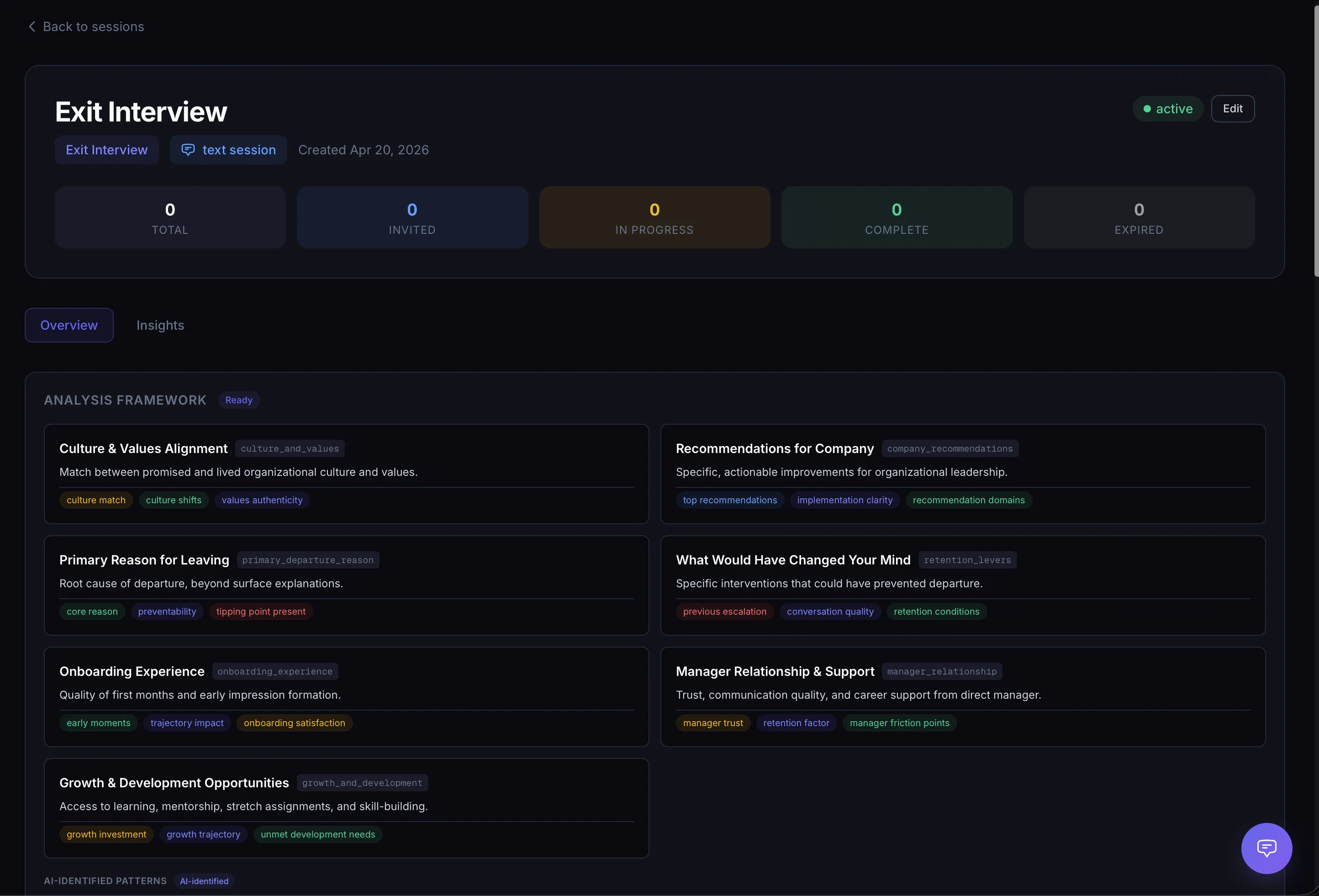
The Listening Difference
Eight minutes of conversation gets you more signal than thirty minutes of a survey. Real conversations surface what checkboxes bury.
How a listening campaign works
- 1 Configure the session type and trigger. Set the questions, the tone, and when sessions fire: on schedule, on event, or on demand. Onboarding, stay, exit, and pulse each have purpose-built templates.
- 2 Employees receive a link and complete at their pace. Mobile-friendly. 8-15 minutes. Private by default. No manager in the room. Response rates are consistently higher than traditional surveys.
- 3 Themes and quotes land in the dashboard. Not transcripts. Extracted themes, ranked by frequency and sentiment, with representative quotes for each. Manager and HR views configurable separately.
- 4 Trend over time. Act on patterns. Compare cohorts. Track theme velocity. Flag when a previously stable team's sentiment shifts. The platform surfaces the signal,action is yours.
Listening Module
Hear what your people actually think.
A demo shows the session flow, the dashboard, and how themes are extracted, mapped to your org structure.
Book a Demo