
Hiring Module
Stop interviewing on vibes.
Start hiring based on evidence.
Structured interviews scored against validated rubrics, delivered at scale by AI. Every decision traceable to the candidate's own words.
What a scorecard looks like
Every score traced to the candidate's own words.
No black box. No unexplained numbers. Every competency score comes with the specific quote from the candidate's response that justifies it,evidence reviewers can read, evaluate, and override.
UNIFIED SUMMARY
ASSESSMENT 1
0.0
AdvanceASSESSMENT 2
0.0
AdvanceStrengths
- Clean code structure
- Tested edge cases
- Well-structured documentation
COMPETENCY SCORES
What the hiring module does
Structured interviews at scale
Every candidate experiences the same competency-based questions in the same order, scored against the same rubric. This eliminates interviewer halo effects and the variance that comes from a mentally checked-out hiring manager at 4pm on a Friday. The consistency is what makes the science work.
Blind scoring with evidence.
Scores are generated before a reviewer sees demographic information. Every score includes the specific quotes from the candidate's responses that justify it. Not a number from a black box,evidence reviewers can evaluate and override.
Résumé parsing with demographic redaction.
Résumés enter the pipeline stripped of name, graduation year, and other demographic signals before a human ever sees them. Parsed work history and skills feed the competency match. Greenhouse integration included, with more ATS connections in progress.
Adverse impact monitoring, always on.
The 4/5ths rule runs automatically at every stage. Selection rate gaps by gender, race, and age are flagged before they become a pattern,or a complaint. Intersectional analysis included, not sold separately.
Full legal documentation from day one.
Job analysis documentation, content validity evidence, adverse impact reports, and scoring rubrics are generated at setup,not assembled after a challenge. UGESP-compliant. EEOC-aligned. NYC Local Law 144 ready.
Hybrid and adaptive delivery.
Voice or text. Fixed or adaptive based on earlier responses. Roles differ: a customer-facing role needs different delivery from a technical individual contributor. Configure once per role, deploy as often as you need.
Candidate Pipeline
See every candidate scored and ranked before you talk to a single one.
The posting overview shows score distribution, competency averages, and Advance / Hold / Decline recommendations across your full pipeline. Spot outliers, compare cohorts, and move forward with confidence.
See it on your roles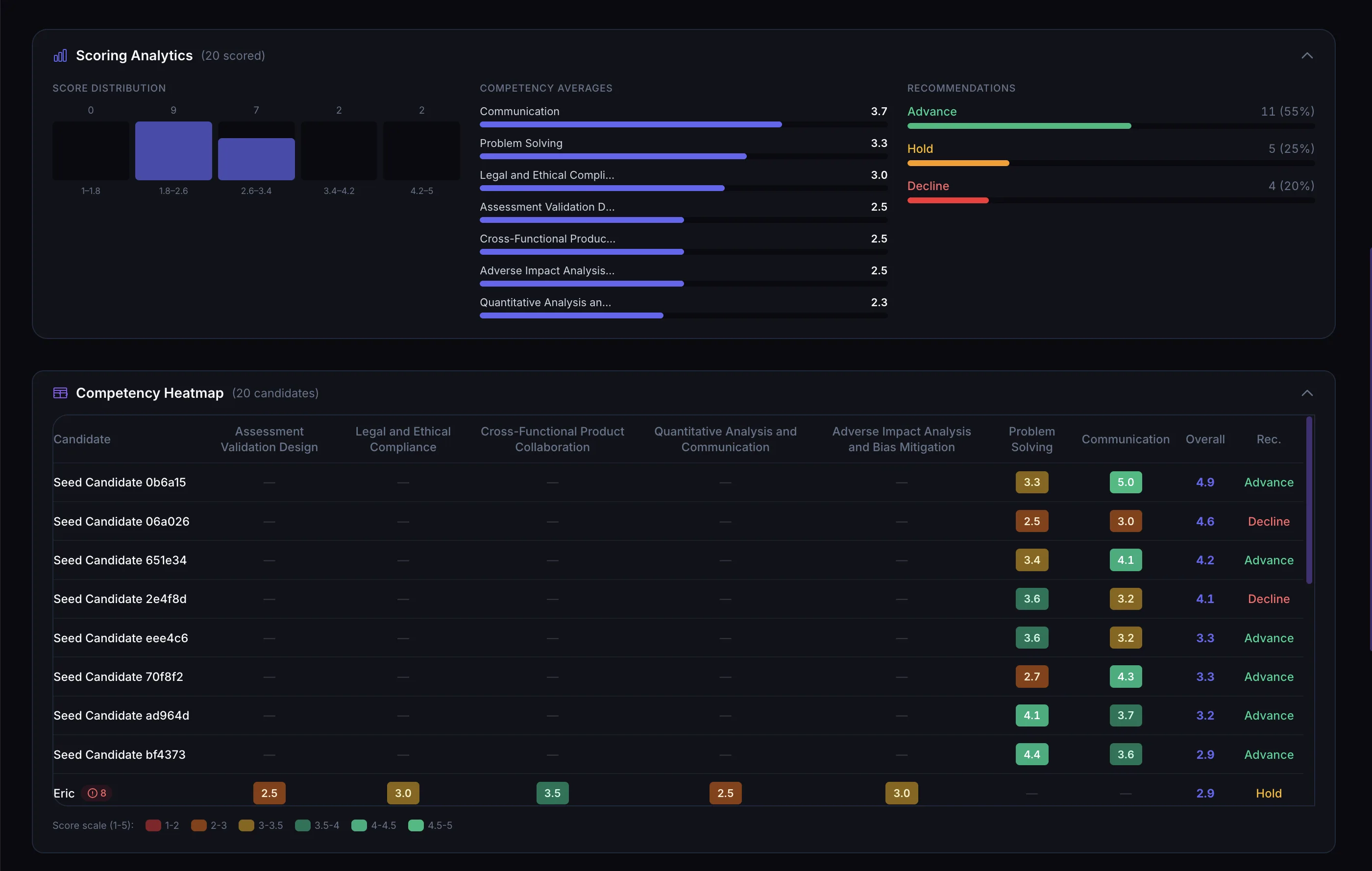
AI Interview Agent
The interview happens without you. The evidence doesn't disappear after it.
Every candidate gets the same structured questions in the same order. The AI probes naturally, the candidate responds on their own time, and every answer is scored against the rubric. What you get back isn't a transcript,it's a scored, evidence-backed report.
"I scoped it down to a safe-to-fail proof of concept, shipped it, and used the real data to make the full call. We hit the deadline and the approach held up in production."
How a hiring run works
- 1 Configure the role. Set competencies, rubric anchors, and compliance settings from our library or build your own. Produces a documented competency framework before a single candidate is assessed.
- 2 Candidates receive a link. They complete a structured AI interview session at their own pace. No scheduling, no panel coordination, no interviewer availability bottleneck.
- 3 Scores and evidence land in the dashboard. Ranked shortlist with competency-by-competency breakdowns and supporting quotes. Adverse impact flags surface immediately.
- 4 You decide. With documentation. Every move in the pipeline is logged. When someone asks why you passed on a candidate,or why you hired them,the answer is already written.
Hiring Module
See it running on your roles.
A demo maps the workflow to your actual hiring context: your competencies, your volume, your compliance requirements.
Book a Demo